
18+ only. T&Cs apply on every operator promotion mentioned. Please gamble responsibly. Support: GamCare, GordonMoody, BeGambleAware.
What a bookmaker loyalty scheme actually rewards
Bookmaker loyalty schemes exist because acquisition is expensive and retention is cheap. Once you have taken the welcome offer, the industry has spent between £50 and £200 to have you as a customer, and it now needs you to stay long enough for the return on that acquisition to break even. Loyalty schemes are the retention lever. Comparing the best loyalty programme betting sites is therefore a comparison of what value the industry is willing to hand back once you have already signed up.
What the schemes actually are varies. Some are turnover-triggered weekly free bets (Sky Bet Club is the visible example). Some are price boosts on multi-legged accumulators (bet365 Bet Boost). Some are seasonal money-back specials that behave like loyalty for regular users of a specific market. All are legitimate; the question is which pay off given how you actually bet.
Read the best betting sites homepage first if you want the underlying economics of welcome offers; loyalty schemes ride on top of that primary layer.
Common mechanics - price boosts, weekly free bets, cashback
The five common mechanics you will encounter are worth naming:
- Price boost. A percentage uplift on a qualifying wager - typical on accumulators.
- Weekly free bet. A free-bet token issued each week if you hit a stated turnover threshold at qualifying odds.
- Cashback. A percentage of net losses over a period returned as cash or free bets.
- Money-back special. Stake returned as free bet if a specific bad outcome occurs.
- Tier-based rewards. Access to higher-value promotions as your account moves up defined tiers.
None of these are exotic. All are variations on the same underlying question: how much extra betting are you willing to do, and how much of that betting is the operator willing to reward with returned value?
bet365 Bet Boost - accumulator uplift explained
bet365 Bet Boost applies a percentage uplift to accumulators of three legs or more. The uplift scales with the number of legs - a five-fold pays out at boosted odds higher than the market implies, and the escalator continues through the higher-leg accumulators. Qualifying rules apply: minimum odds per leg, minimum overall stake, no cash-out on boosted wagers.
The economics work for a bettor who was already placing multi-leg accumulators as a matter of routine. The boost is real additional return on a winning ticket. It is not a reason to add legs to an existing accumulator to chase a higher boost tier - the reduced probability of winning almost always outweighs the increased boost.
The boost applies to sportsbook accumulators only and does not apply to system bets, request-a-bet or bet builder accumulators (which often have their own separate offers).
Sky Bet Club - weekly free bet on a turnover trigger
Sky Bet Club is a weekly free-bet scheme keyed to a minimum weekly turnover. The standard offer through 2026 is: place £25 of qualifying wagers at odds of 1/2 or higher between Monday and Sunday, and receive a £5 free-bet token the following week. Weekly - not monthly, not one-off.
The value proposition depends on whether the £25 threshold matches your natural betting cadence. If you routinely place £30-£50 of wagers per week anyway, the £5 free bet is real value on top - roughly 15-20 per cent uplift on your weekly outlay. If you have to stretch your betting to hit the threshold, the arithmetic reverses: the £5 free bet costs more in additional variance than it returns.
The membership itself is free to activate and does not require opt-in per week - once enrolled, the trigger runs automatically.
Betfred Double Delight, Goals Galore and Football Pools links
Betfred maintains a rotating slate of recurring promotions rather than a single loyalty scheme. The two most visible over time are Double Delight and Hat-Trick Heaven (double odds on the first goalscorer in a game where two are scored, triple odds if three are scored - applied to specified match odds), and the Football Pools cross-sell.
Double Delight and Hat-Trick Heaven are a de facto loyalty benefit for bettors who back first goalscorers regularly. If a first goalscorer is your usual market, the promotion is straightforward upside on winning tickets. If it is not, the promotion is worth nothing.
The Football Pools cross-sell has been running since Betfred acquired The Football Pools in 2019 and is a wholly separate product with its own terms. It is worth noting the connection because Betfred's marketing frequently ties the two together.
William Hill, Coral and Ladbrokes recurring promotions
William Hill, Coral and Ladbrokes each run recurring promotions that behave like loyalty benefits even if not branded as such. The common pattern is a weekly or fortnightly free-bet offer keyed to placing a qualifying stake in a specific market - Premier League match odds, Grand National each-way, a specific ATP tennis tournament.
These are worth tracking if the qualifying market matches what you already bet on. They are not worth changing your betting pattern to chase. William Hill's Racing Club and Coral's Extra Places on horse racing are the two long-running examples that reliably return value to regular racing punters.
None of these three operators runs a single unified points-based scheme in the way that some Continental operators do. The UK model has settled on a series of narrow, market-specific promotions rather than a global reward layer.
Paddy Power money-back specials as de facto loyalty
Paddy Power operates a series of money-back specials that function as de facto loyalty benefits. The pattern is: place a specific type of wager (each-way on a horse, first goalscorer in a football match, a specific tennis outright), and if a specific bad outcome occurs, the stake is refunded as a free bet.
Money-back specials are subtler than loyalty benefits in the traditional sense because they only pay when things go wrong in a defined way. Their value is stochastic - most of the time they pay nothing, and occasionally they pay the full stake as a token. Over a long enough period, the expected value is genuinely positive for bettors who use the covered markets regularly.
The catch to watch is the market definition, which is often narrower than the banner suggests. "Money back if second" applied to horse racing typically means second to the SP favourite only, not second in the race.
Value vs behaviour change - the honest reading
The honest reading of loyalty schemes is that they are value if they do not change your betting pattern, and they are cost if they do. That is the whole framework.
- Would you have placed the qualifying wagers anyway? If yes, the loyalty reward is genuine upside.
- Are you being asked to place a wager type you do not normally use? If yes, the reward is behaviour-change disguised as value.
- Are you being asked to increase your normal stake? If yes, the reward is almost certainly negative expected value.
The industry knows this. The best loyalty programmes are the ones designed to reward routine users of a specific market and not to attract new betting into that market. Sky Bet Club is close to this ideal because £25 per week at 1/2 or higher is a natural threshold for a regular Premier League bettor.
Loyalty scheme comparison table
| Operator | Scheme | Trigger | Reward | Cadence |
|---|---|---|---|---|
| bet365 | Bet Boost | Accumulator of 3+ legs | Percentage odds uplift | Per wager |
| Sky Bet | Sky Bet Club | £25/week qualifying turnover | £5 free bet | Weekly |
| Betfred | Double Delight | First goalscorer market | Double odds on goals 2+ | Per wager |
| William Hill | Extra Place | Each-way on horse racing | Extra place | Per race |
| Coral | Best Odds Guaranteed | Pre-match horse racing | Best of price / SP | Per bet |
| Ladbrokes | Acca Insurance | 5+ leg accumulator | Stake as free bet if one loses | Per bet |
| Paddy Power | Money-back specials | Various narrow markets | Stake as free bet on bad outcome | Per bet |
| Unibet | Odds Boost | Various markets | Percentage boost | Rotating |
None of the schemes above requires a subscription fee. All require you to opt in at the operator's promotions panel.
Frequently Asked Questions
Do loyalty schemes stack with welcome offers?
Not typically. The welcome offer is your first-time offer; loyalty schemes activate once the welcome offer's qualifying wager has settled and any first-week bonuses have expired.
Can I be on multiple loyalty schemes at once?
Yes, across different operators. You cannot stack multiple loyalty schemes at the same operator - the scheme is tied to your account.
Do loyalty rewards count as taxable income?
No. UK betting winnings are not taxable, and loyalty rewards are treated as betting winnings for this purpose.
Are loyalty rewards issued as cash or as free-bet tokens?
Almost always as free-bet tokens. The token mechanic applies - typically stake-not-returned, with minimum odds and expiry conditions.
Can I earn loyalty benefits on cash-out bets?
Cash-out typically voids the wager for loyalty-tracking purposes. Wagers that settle to the market count; wagers cashed out early usually do not.
Do loyalty schemes change without notice?
Operators reserve the right to change or withdraw promotions with reasonable notice. Weekly schemes are usually stable across seasons; per-wager promotions rotate more.
How do I check my current loyalty tier?
Most operators display current tier and progress in the account panel. If it is not visible, contact support.
Responsible Gambling
Loyalty schemes are designed to make you bet more, not less. The honest test is whether the scheme's threshold matches your natural cadence or requires you to stretch. If it requires stretching, that is a signal.
UK support: GamCare (0808 8020 133), GordonMoody, NHS National Gambling Clinic, BeGambleAware, GAM-Anon. Text mentions only.
Loyalty scheme history in the UK market
Loyalty schemes in UK bookmaking have a long history. Retail-first operators (Ladbrokes, Coral, William Hill) began experimenting with punter-reward schemes in the late 1990s as retail competition intensified. Online-native operators (bet365, Sky Bet, Betfair) started building recurring digital promotions from the mid-2000s. The two lineages produced different shapes - retail loyalty tended toward stamp-based reward and cash-back on losses, digital loyalty tended toward algorithmic price boosts and turnover-based free bets - and the modern UK market carries elements of both.
The Sky Bet Club, launched in the mid-2010s, is often cited as the archetype of the modern turnover-triggered free-bet scheme because its qualifying threshold (£25 per week at 1/2 or higher) matches a realistic betting pattern rather than requiring a stretch. bet365's Bet Boost, in a similar timeframe, established the escalating-percentage accumulator uplift as an alternative model that rewards a specific bet type rather than a general turnover threshold. Both models have been widely imitated.
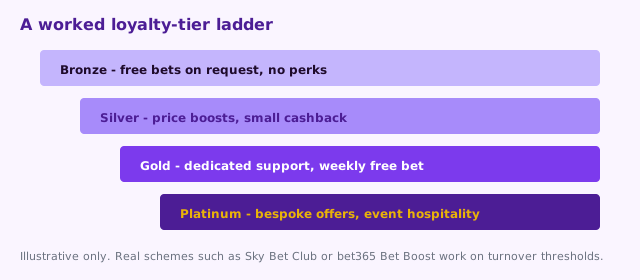
What has not really emerged in the UK market, in contrast to some Continental European markets, is a genuinely unified points-based programme that grants tiered benefits keyed to lifetime turnover. The closest UK analogues (Betfred's rotating slate, William Hill's Racing Club) are narrower than a fully integrated tier system, and the reason is arguably regulatory: LCCP marketing rules make wide-scope tier promotions harder to advertise cleanly than narrower per-market rewards.
How to compare loyalty across operators
The useful comparison method is not to line the schemes up side by side - they are structurally different and do not compare directly - but to apply the honest test in the value-vs-behaviour-change section to each scheme individually. Would you have placed the qualifying wager anyway? If yes, the reward is real value. If no, the reward is behaviour-change disguised as value and should be discounted accordingly.
The other useful comparison is the expiry and issuance mechanics of the reward itself. A £5 weekly free bet issued with a 7-day expiry and evens minimum odds is worth less than a £5 weekly free bet issued with a 30-day expiry and 1/2 minimum odds, because the tighter constraints reduce the range of usable selections. Read the reward's terms in the same way you would read a welcome-offer's significant terms.
Loyalty scheme opt-out
Every UKGC-licensed loyalty scheme is opt-in and can be opted out of at any time from the account panel. Opting out does not affect the underlying account or its balance; it simply removes you from the promotional stream. If a loyalty scheme is prompting you to bet more than you want to, opting out is the cleanest response, and it takes under a minute.
Some operators automatically opt existing customers into new promotions unless the customer has previously set marketing preferences to opt out. Reviewing your marketing preferences once a year is a light-touch way to keep the promotional flow at a level you are comfortable with.
Loyalty and affordability
UKGC social responsibility rules require operators to monitor for signs of affordability strain. A loyalty scheme that is being triggered by a rapid rise in customer stakes is one of the signals operators are required to consider. Do not assume that hitting the qualifying threshold week after week is invisible to the operator - the pattern is monitored, and unusual changes may trigger affordability checks. That is a consumer protection, not a nuisance.
If you find that you are consistently just above the qualifying threshold week after week, and the pattern is nudging your betting upward rather than the other way around, take that as a signal to review your betting cadence honestly.