MB Info logoMB Info

Compared Best Free Bet Offers UK 2026 — Tokens Explained

The best free bet offers uk operators issue are stake-not-returned tokens under a bet-and-get structure.

For the mechanics of welcome offers as a whole, see the best betting sites homepage.

18+. T&Cs apply. Please gamble responsibly.

18+ only. T&Cs apply on every operator promotion mentioned. Please gamble responsibly. Support: GamCare, GordonMoody, BeGambleAware.

The UK free-bet landscape in 2026

The free-bet token is the working currency of UK sports promotions. Whether you are chasing the best free bet offers uk operators run or comparing the ongoing loyalty schemes, most of what you receive from a bookmaker beyond the odds themselves comes packaged as tokens. Understanding what a token is - and, more importantly, what it is not - lifts the value of every offer you take.

The 2026 market is dominated by stake-not-returned tokens issued through bet-and-get welcome offers. Every operator you would recognise - bet365, William Hill, Paddy Power, Sky Bet, Betfair, Ladbrokes, Coral, BetVictor, Unibet, 888sport, Boylesports and Betfred - issues them, and each has small structural differences around minimum odds, expiry and eligible markets.

If you have not already read the underlying explainer on the best betting sites homepage, that is the right starting point. This page then goes deeper on the mechanics of the tokens themselves.

What a free-bet token actually is

A free-bet token is a promotional credit tied to a single wager. It is not cash. It cannot be withdrawn. It cannot be transferred. It cannot be broken up into two smaller tokens (unless the operator explicitly issues them as multiple separate tokens). It is a one-shot instrument: you place a bet using it, and after the wager settles - win or lose - the token is consumed.

The token typically has three attributes attached. A face value, in pounds. A minimum-odds clause, which restricts the price you can back with the token. And an expiry, after which the token becomes void. Some tokens also carry market restrictions (specific sports, specific bet types) - these are usually stated in the summary at the top of the account's promotions panel.

What a token is not is a substitute for money that behaves like money. If your qualifying wager wins and you receive £30 in free-bet tokens, your account balance shows £30 more of tokens - not £30 more of cash. The tokens will not pay for a withdrawal, will not settle account fees, and cannot be moved between accounts.

Stake-returned vs stake-not-returned in detail

The stake-returned distinction is the single most-misread mechanic in the UK free-bet market, and it is the one most worth understanding before you place a token.

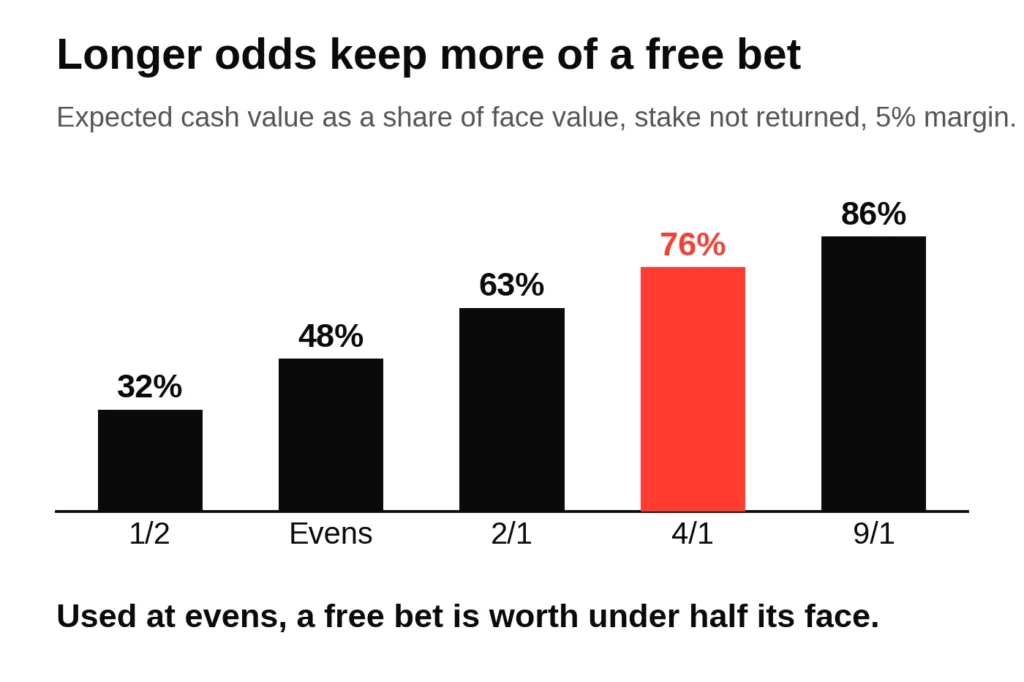
On a stake-not-returned token, a winning wager pays the winnings only, not the stake. A £10 token at even money returns £10 in cash. A £10 token at 4/1 returns £40. A £10 token at 1/2 returns £5. In every case the token itself is consumed.

On a stake-returned token (rarer in the UK), a winning wager pays the winnings and the stake. A £10 token at even money returns £20. At 4/1, £50. At 1/2, £15. Stake-returned tokens are correspondingly more valuable, all else equal.

In the 2026 UK market, essentially all mainstream operators issue stake-not-returned tokens as standard. The occasional stake-returned promotion turns up as a specific limited-time offer, usually flagged as "double the odds" or "extra winnings". Read the significant terms; the phrase "stake not returned with winnings" is a required disclosure.

Token splits and multi-token issuance

How the operator issues the tokens matters. A single £30 free-bet token is a different instrument from three £10 free-bet tokens. Three £10 tokens can be spread across three different fixtures, which lowers variance; a single £30 token is one shot.

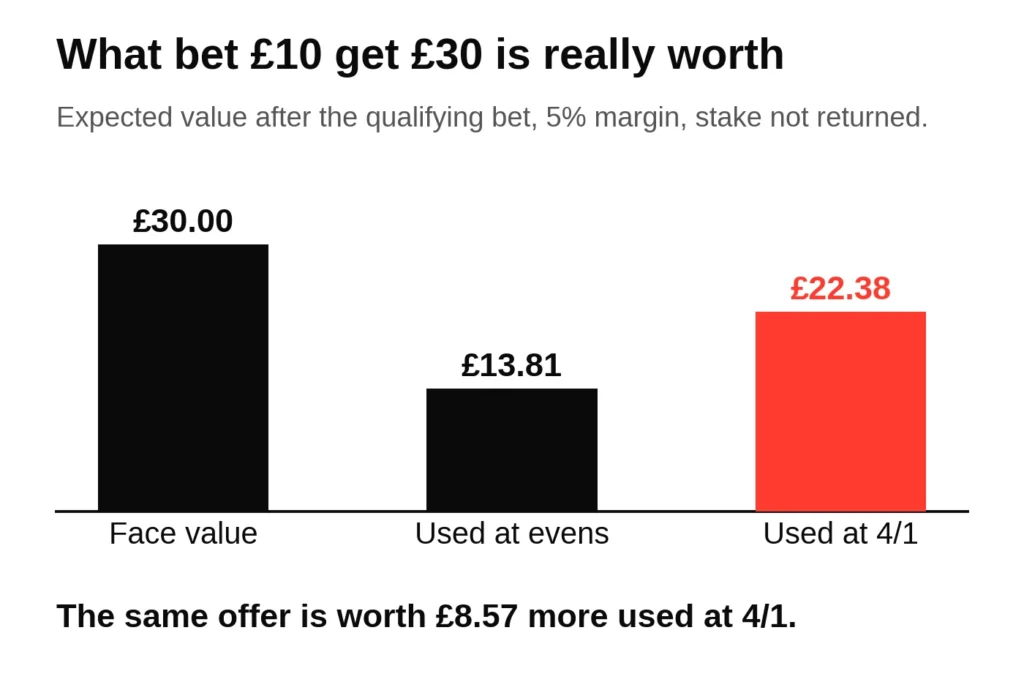
The dominant issuance pattern among the leading UK bookmakers is 3x separate tokens on a "Bet £10, Get £30" welcome. Paddy Power's headline "Bet £10, Get £40" typically issues as four £10 tokens. Some smaller operators issue as one large token; check the terms.

Multiple smaller tokens are generally more useful because they let you spread across a weekend of football rather than betting your whole allowance on a single fixture. That said, the mathematics of stake-not-returned favours placing each token at higher odds rather than short prices, so "spread thin" does not mean "back the favourites".

Timeline of free-bet expiry windows from 24 hours to 30 days used by UK bookmakers
Token expiry windows in the current UK market.

Qualifying wagers that trigger a token

The qualifying wager triggers the token, and getting it wrong is the most common way to lose the offer. The three variables to get right are the wager amount, the wager odds and the wager timing.

The safest qualifying wager is a single-line pre-match bet in a market that will settle within 24 hours - a match result, over/under 2.5 goals, a first goalscorer. Multiple-line accumulators are eligible but the accumulator only settles when the last leg does, which slows down the trigger.

Odds rules and market exclusions to know

Once the tokens are in your account, the rules that apply to their deployment are almost always looser than the qualifying-wager rules. Most operators allow tokens to be spent on any market that meets the minimum-odds floor, at any price above that floor. Some operators impose a token-specific market exclusion (typically horse racing during Cheltenham week, for arbitrage-prevention reasons) - check the token's terms.

The other rule to check is whether the token can be used on in-play markets. Most can; a minority cannot. If you were planning to use the token on a live football fixture, confirm eligibility before the fixture kicks off.

A useful pattern for tokens with a 1/2 or 4/5 minimum is to deploy on a mid-price selection you have a genuine view on - a specific first-goalscorer, an each-way stake on a value horse, a specific correct-score bet. The lower-variance move of backing an odds-on favourite is mathematically weaker on a stake-not-returned token.

Expiry, timing and diary discipline

Token expiry is where casual bettors lose the most value. A 7-day expiry sounds like plenty of time until the week runs away and you look at the promotions panel on the wrong Wednesday. The mitigation is simple: set a diary reminder for the day before expiry, and if you have not spent the token by then, decide on the spot.

The most common expiry windows in the current UK market are 7 days (short) and 30 days (generous). Sky Bet, Betfair, William Hill and Paddy Power sit at 30 days. Ladbrokes, Coral, Betfred and 888sport sit closer to 7 days. bet365 uses 30 days on Bet Credits.

Do not treat "expiry" as a soft deadline. Tokens are voided at the second they expire, and there is no rollover, extension or reissue at operator discretion.

How to deploy tokens for best expected value

The mathematically-driven pattern for deploying a stake-not-returned token is: single-line, mid-to-higher odds, on a market you would have bet anyway. Splitting a £30 token into three £10 tokens across three matches is fine; splitting it across nine 5/1 accumulator legs is not.

  1. Deploy at odds no lower than the minimum-odds floor, and ideally higher.
  2. Single-line where possible. Accumulators multiply the variance without proportionally increasing the expected value of the token.
  3. Avoid cash-out; tokens typically ineligible.
  4. Avoid combining tokens with existing hedge positions - most operators void the token if it is used to systematically arb an accumulator.
  5. Set a diary reminder for the expiry date.

None of this requires spreadsheets. It is the mental discipline of treating the token as one betting decision rather than as spare change.

Worked examples across three operators

Three worked examples make the mechanics concrete.

Example 1 - bet365 Bet Credits, £30 as 3x £10. Minimum odds 4/5, expiry 30 days. Deploy Token A at 5/6 on a match-result you have a view on. If it wins, £8.33 in cash. Deploy Token B at 2/1 on an each-way horse. If it wins, £20 win + £4 place = £24. Deploy Token C at evens on a first-goalscorer. If it wins, £10.

Example 2 - Paddy Power £40 as 4x £10. Minimum odds evens, expiry 30 days. Deploy each £10 on a different Premier League fixture at odds between evens and 2/1. Expected token return roughly £13-£16 depending on selections.

Example 3 - Ladbrokes £20 as 4x £5. Minimum odds evens, expiry 7 days. Deploy across a single Saturday of football. Expected return roughly £7-£9 depending on which matches you back.

None of these examples are guarantees - they are illustrative of the arithmetic. Actual returns depend on selections and outcomes.

Diagram of a UK welcome offer including free-bet tokens issued after a qualifying wager
The free-bet token is the last step in the standard UK welcome-offer flow.

Frequently Asked Questions

Do free-bet tokens count toward wagering requirements?

Usually no. Stake-not-returned tokens are one-shot instruments and do not contribute to any separate wagering requirement on a deposit bonus.

Can I combine two tokens on a single accumulator?

Only if the operator explicitly permits it, which is rare. Most operators require each token to be used on a separate bet slip.

What happens if my token-backed wager is voided?

The token is typically reissued to your account with the same expiry it originally carried. Confirm the reissue timing in the operator's terms.

Can I withdraw my free-bet token?

No. Tokens are promotional credits and are not withdrawable. Only cash winnings from token-backed wagers can be withdrawn.

Do tokens work on virtual sports or eSports?

Sometimes. Most operators exclude specific virtual-sports markets and permit mainstream eSports. Check the token's terms.

Are tokens taxable in the UK?

No. UK betting winnings are not subject to income tax for the punter, whether won from a cash stake or a token.

Can I refuse a token if I do not want the offer?

Yes. Contact the operator's support and ask to opt out of the promotion before placing the qualifying wager.

Responsible Gambling

Free-bet tokens are cheap to spend - it is not your own money you are staking - which is exactly why they are worth being thoughtful about. If a token is prompting you to bet on a market or a fixture you would not otherwise touch, the token has done its job for the bookmaker and probably not for you.

UK support: GamCare (0808 8020 133), GordonMoody, NHS National Gambling Clinic, BeGambleAware, GAM-Anon. Text mentions - please look them up.

18+ - please gamble responsibly. All welcome offers discussed in this article are UKGC-licensed. T&Cs apply. If gambling stops being fun, help is available - GamCare (0808 8020 133), GordonMoody, NHS National Gambling Clinic, BeGambleAware, GAM-Anon. Never bet money you cannot afford to lose.

How token issuance has changed over five years

Between 2020 and 2026 the shape of the free-bet token has evolved in three visible ways. The average expiry window has shortened - 30 days remains the market ceiling but 7 days has become far more common on the sharper end of the bet-and-get market. The average minimum-odds floor has risen slightly, with more offers moving from 1/2 to evens as operators seek to prevent low-variance arbitrage. And the share of tokens issued as multiple smaller instruments rather than a single large one has grown, which is broadly positive for consumers because it lets the reward be spread across multiple fixtures.

None of these changes is dramatic on its own. All three, taken together, reflect an industry that has become better at defending the economics of its promotional stack. The consumer defence is the same as it was five years ago: read the significant terms, apply the token to a market you would have bet on anyway, and treat the expiry as a hard deadline rather than a soft one.

The other trend worth noting is the growing sophistication of "bonus abuse" detection on the operator side. Attempts to arb tokens across multiple accounts, to use tokens with a coordinated hedge on an exchange, or to bet tokens on markets where matched-book patterns are visible, are routinely flagged and voided. The market operates on the assumption that tokens are for individual recreational use, and that assumption is enforced.

A short worked note on token expected value

The expected value of a stake-not-returned token deployed at odds X, on a selection with true win probability P, is (X - 1) * face_value * P. On a £10 token at even money (X = 2.00) with a fair-market selection (P around 0.5), the expected value is (2 - 1) * 10 * 0.5 = £5. On a £10 token at 4/1 (X = 5.00) with a fair-market selection (P around 0.2), the expected value is (5 - 1) * 10 * 0.2 = £8. Higher odds increase expected value on a stake-not-returned token, provided the selection is priced accurately by the market.

The takeaway is not "always back the biggest outsider you can find with the token". The takeaway is that the mathematical case for backing shorter prices with a token is weaker than the case for backing longer prices, and the anti-mathematical instinct to "spend the token safely on a favourite" costs you value.

Token risk profile compared to cash

The risk profile of a token differs from cash in one important way. Cash carries downside - if you bet £10 of your own money on a losing selection, you lose £10. A stake-not-returned token carries no downside beyond the opportunity cost of the token itself; a losing wager loses only the token, and the token was not your money. That asymmetry can quietly encourage riskier selections than you would place with cash, which is neither good nor bad in isolation - it depends on whether the selection is one you have a genuine view on.

The cleanest defence against token-driven bad discipline is to treat the token exactly as if it were cash for the purposes of choosing a market. Ask yourself the same question you would ask before staking £10 of your own money. If the answer is yes, deploy the token; if the answer is no, do not spend the token to justify a market you would not otherwise have entered.

Free bets and exchange betting

The exchange betting model (Betfair Exchange is the visible UK example) does not typically issue tokens in the same shape as the sportsbook side, because exchange revenue comes from commission on winning bets rather than from margin on the price. Where tokens are issued on the exchange side, they usually take the form of commission discounts or specific market-level cashback rather than stake-not-returned free-bet credits. Read the exchange terms - they are structurally different from sportsbook terms and the same intuitions do not apply.