
18+ Betting can harm. Stop, take a breath, think before you bet.

Darts

Darts Betting Sites UK 2026 for Every Format

Darts betting moves faster than almost any other sport, and the format decides the price as much as the player does. We modelled how legs, sets and the throw turn a player’s edge into a match price, and ranked books on match margins, the depth of 180 and checkout markets, in-play speed and how they treat a winning account.


Avatar photo By Tom Lunn Updated Fact-checked by Tom Lunn
Darts betting: a dartboard under a spotlight with three darts, one with a red flight

Top darts betting sites for UK punters 2026

Bet Bluff
9.8 (9.8/10)
  • Exclusive Free Bet Deal
  • Smart Bet Builder
  • Fast Cash-Out
Bonus
EXCLUSIVE WELCOME SPORTS FREEBET
Bet £25 +
Get £50 Freebet!
Spinny Casino
9.5 (9.5/10)
  • Dedicated Sports Welcome Bonus
  • High-Yield Odds
  • Quick & Secure Payouts
Bonus
WELCOME SPORTS FREEBET
UP TO £100
FREEBET
Wettson
9.3 (9.3/10)
  • Exclusive Free Bet Promo
  • Live Match Statistics
  • Flexible Payments
Bonus
EXCLUSIVE WELCOME SPORTS FREEBET
Bet £25 +
Get £50 Freebet
GladiatorsBet
9.2 (9.2/10)
  • Exclusive Free Bet Package
  • Boosted Combat & Football Odds
  • Action-Packed Live Console
Bonus
EXCLUSIVE WELCOME SPORTS FREEBET
Bet £25 +
Get £50 Freebet!
Fiesta Slots
9.0 (9.0/10)
  • Exclusive Free Bet Voucher
  • Extensive Global Markets
  • Mobile-Optimized Interface
Bonus
EXCLUSIVE WELCOME SPORTS FREEBET
Bet £25 +
Get £50 Freebet!
Roibets
8.9 (8.9/10)
  • Default Welcome Free Bet
  • Accumulator Odds Boosts
  • Comprehensive In-Play Hub
Bonus
WELCOME SPORTS FREEBET
UP TO £100
FREEBET
Lolo Casino
8.5 (8.5/10)
  • Dedicated Sports Welcome Offer
  • Top Football Odds
  • Streamlined Registration
Bonus
WELCOME SPORTS FREEBET
UP TO £100
FREEBET
Froggybet
8.4 (8.4/10)
  • Dynamic Live Betting
  • All-In-One Sportsbook
  • Intuitive Navigation
Bonus
100% Welcome Sports Freebet
Emberbet
8.1 (8.1/10)
  • Exclusive Free Bet Incentive
  • Hot Odds Boosts
  • Instant Cash-Out Control
Bonus
EXCLUSIVE WELCOME SPORTS FREEBET
Bet £25 +
Get £50 Freebet!
Reel Raven
8.1 (8.1/10)
  • Exclusive Free Bet Deal
  • Custom Bet Builder
  • 24/7 Live Markets
Bonus
EXCLUSIVE WELCOME SPORTS FREEBET
Bet £25 +
Get £50 Freebet!
Luck Leopard
7.7 (7.7/10)
  • Exclusive Free Bet Bonus
  • Extensive Horse & Football Coverage
  • Fast Cashouts
Bonus
EXCLUSIVE WELCOME SPORTS FREEBET
Bet £25 +
Get £50 Freebet!
JasminSlots
7.5 (7.5/10)
  • Special Sports Welcome Package
  • Competitive Market Odds
  • Fast Account Verification
Bonus
EXCLUSIVE WELCOME SPORTS FREEBET
Bet £25 +
Get £50 Freebet
Andromedasino
7.2 (7.2/10)
  • Exclusive Free Bet Sign-Up
  • Interactive Live Match Stats
  • Top-Tier Odds
Bonus
EXCLUSIVE WELCOME SPORTS FREEBET
Bet £25 +
Get £50 Freebet!

What makes a good darts book

A darts match can be over in fifteen minutes, so the book has to price it well before the walk-on and keep up once the first dart lands. We check the match price first, then the side markets, then how the book behaves once you win. They follow the tests in our main bookmaker ranking, applied to darts.

  • Match odds margin on the big events and on the smaller European Tour and floor events
  • Market depth: handicaps, total legs and sets, correct score, 180s, highest checkout
  • In-play: how fast the book reprices after each leg and how often it suspends
  • Outrights: each way terms and how early the tournament markets open
  • Limits: maximum stakes on darts, and how the book treats an account that wins

How a darts match is priced

A darts match is a race. Each leg starts at 501 and ends when a player checks out on a double, and the match goes to the first player to reach a set number of legs, or of sets, each set a race to three legs. A book prices the match from one number, the chance each player wins a single leg, and the format does the rest.
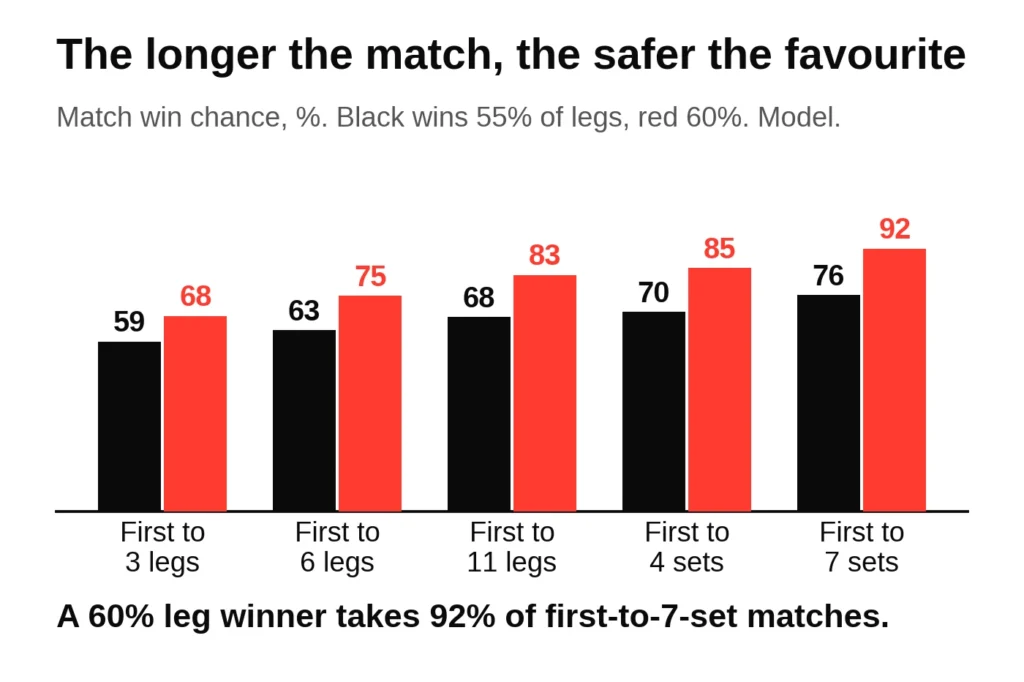
  • Short formats, first to 3 or 6 legs: a small edge per leg is only a small edge in the match
  • Long formats, first to 11 legs or several sets: the same edge compounds into a big one
  • Sets add a second layer: winning a set is itself a race, so the stronger player gains twice
Chart of how match length changes a darts favourite's chance of winning, from first to 3 legs to first to 7 sets
Model: chance of winning the match for a player who wins 55 or 60 per cent of legs, legs treated as independent with no allowance for who throws first. Sets are first to 3 legs.

Turning a leg edge into a fair price

Once you have a match chance, the fair price is one divided by it. Take the model’s first-to-6-leg match with a 60 per cent leg winner: the favourite wins 75.3 per cent of the time and the underdog 24.7 per cent.

  • Fair price on the favourite: 1.33 in decimal odds, about 1/3
  • Fair price on the underdog: 4.05, about 3/1
  • A book working to a 6 per cent margin would offer about 1.25 and 3.80 instead
  • If the same two players met over first to 11 legs, the fair favourite price would shorten to about 1.21

Checking a price this way takes a minute and tells you whether a book has allowed for the format at all.

Why the format matters as much as the player

The same two players can be a near coin toss on a Tuesday floor event and a heavy favourite and outsider in a world final. A 55 per cent leg winner is a 59 per cent chance over first to 3 legs and a 76 per cent chance over first to 7 sets. If a price does not move with the format, one side of it is wrong, and short-format underdogs are where books most often leave value.

Holding and breaking the throw

The player who throws first in a leg gets the first shot at a finish, and at the top level that is worth a lot. Winning a leg you started is holding throw; winning one your opponent started is a break. The throw alternates leg by leg, and in sets play the first throw alternates set by set.

  • A match between two strong scorers often turns on one or two breaks
  • Holding throw is the expectation in the elite game, so an early break moves the price sharply
  • In a first-to-6-leg match the player throwing first in a deciding leg is favourite before a dart is thrown

None of this is visible in the pre-match price, which is one reason darts suits betting in running.

Illustration of the oche line and a dartboard, for holding and breaking the throw
Illustration: the oche and the board. Who throws first in each leg shapes the match more than most punters allow for.

Handicaps, totals and correct scores

Side markets split the match into outcomes that are each far less likely than the win. In our model of a first-to-6-leg match where the favourite wins 60 per cent of legs, the favourite wins the match 75 per cent of the time, but no single score is more likely than one in six.
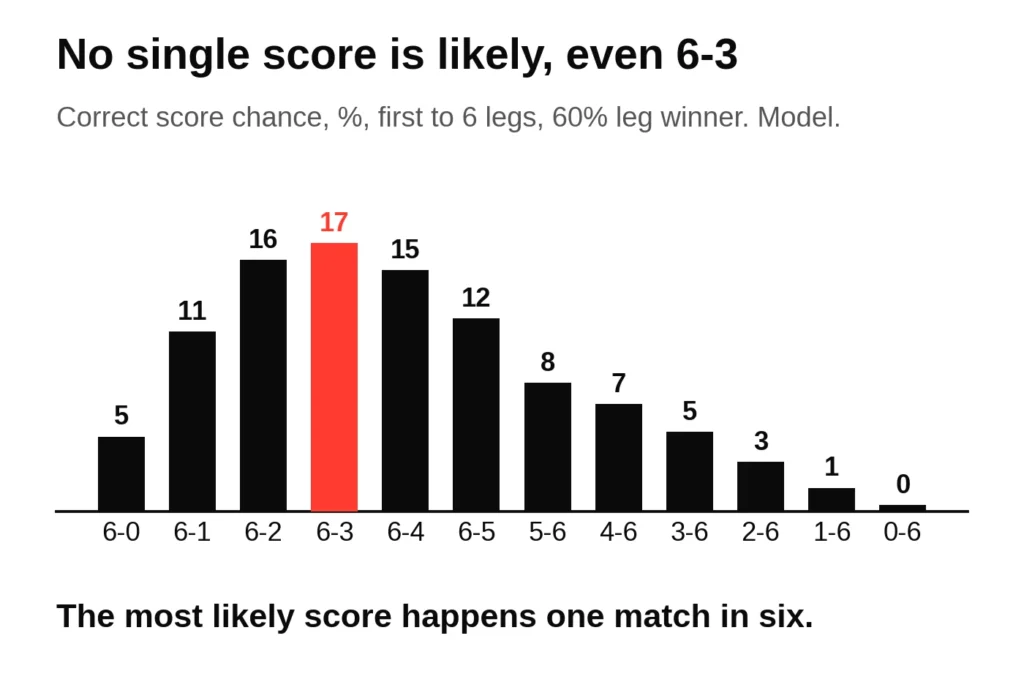
  • 6-3 is the most likely score at 16.7 per cent, then 6-2 at 15.7 and 6-4 at 15.0
  • A whitewash, 6-0, happens 4.7 per cent of the time
  • The favourite on a minus 1.5 legs handicap, winning by two or more, lands 63.3 per cent of the time
  • Over 8.5 total legs, the match going to nine legs or more, lands 63.4 per cent of the time
Chart of the chance of each correct score in a first-to-6-leg darts match
Model: chance of each correct score in a first-to-6-leg match where the favourite wins 60 per cent of legs, legs treated as independent. Favourite wins on the left, underdog wins on the right.

What over 1.5 means in darts betting

Over 1.5 is a totals line: the bet wins if the count reaches two or more. On a sets match it means at least two sets; on a 180s market it means at least two maximums; on a player’s line it can mean two or more 180s by one player. Books use half numbers so a total can never land exactly on the line, which means there is no push and no stake returned. The price you get on either side of the line carries the same margin built into every price as the match.

180s, checkouts and nine-dart finishes

Darts scoring produces its own markets, and they are some of the most popular with British punters because they have little to do with who wins.

  • Most 180s: which player hits more maximums, often with a handicap for the heavier scorer
  • Total 180s in the match: over or under a line that rises with the length of the format
  • Highest checkout: which player takes out the biggest finish, up to the maximum of 170
  • A 170 checkout in the match, and a nine-dart finish, priced as specials, usually at long odds
  • Checkout percentage and averages are the numbers behind all of these, and both are published after every match
Illustration of a single dart with a red flight, for 180s and checkout markets
Illustration: a single dart. 180s and checkout markets settle on scoring, not on who wins the match.

Darts in play, leg by leg

Darts is one of the easiest sports to follow for live betting on a match: every leg is a self-contained contest and the price resets after it.

  • Markets reprice after every leg and often after every visit to the board
  • A break of throw moves the match price more than anything else
  • Pictures and data reach you after they reach the book, so prices can move before you see why
  • Leg winner markets, the player to win the next leg, turn over within a couple of minutes

Darts outrights and each way

A tournament winner market lists every player in the draw, and most of the field is priced at long odds. The draw shapes the price as much as form: a player whose quarter of the draw is weak is shorter than his average alone would suggest.

  • Outright markets open weeks before the big events, and prices shorten as the draw is made
  • Books offer each way terms on the majors, paying a fraction of the odds for reaching a set stage
  • Quarter winner and top-half markets split the draw into smaller fields at shorter prices
  • Money on an outright is tied up for the length of the event, often three weeks at the World Championship

The World Championship at Alexandra Palace

The PDC World Darts Championship is the biggest betting event of the darts year. It runs from mid-December into the first days of January at Alexandra Palace in London, and it is played in sets, which is why the favourites win more often than in any other event.

  • Sets format throughout: each set is first to 3 legs, and the early rounds are first to 3 sets
  • The final is first to 7 sets, the longest format in the game, which the model shows favours the better player most
  • A field of 128 means the outright market carries a wide margin, like any market with many runners
  • Outright prices move sharply once the draw is published, weeks before the first match

When the big darts events are played

Televised darts runs through almost the whole year, and the betting markets follow the major events.

  • February to May: the Premier League, one night a week, knockout format with legs
  • March: the UK Open
  • July: the World Matchplay in Blackpool, a long legs format
  • Autumn: the World Grand Prix, played double in, double out, so every leg must start on a double
  • November: the Grand Slam and the Players Championship Finals
  • December to January: the World Championship
  • All year: European Tour and Players Championship floor events, where prices are softer and limits are lower

Floor events and the European Tour

Away from the television stages, the tour plays dozens of Players Championship floor events and European Tour weekends every year, with hundreds of matches priced by every book.

  • Short formats, often first to 6 legs, where upsets are common and underdog prices are often generous
  • Less market attention, so opening prices can be slow to reflect current form
  • Lower maximum stakes than on the majors, and limits arrive sooner for accounts that win
  • Streams are patchy, so in-play betting relies on the scoreboard

Darts accumulators

A night of darts gives you a card of six or more matches, which makes the sport a natural fit for darts accumulators. Each leg of the acca carries its own margin, so the cost multiplies with every selection, and short-format matches are closer to coin tosses than their prices suggest. Doubles and trebles on long-format favourites are the cheapest multiples darts offers.

What actually predicts a darts result

Most darts tips are opinions on the night. The numbers that move a price before the market catches up are public and free to check.

  • Three-dart average over the last few months, not the career figure
  • Checkout percentage, which decides tight matches more than scoring does
  • The format: back the better player over long formats and look for value on underdogs over short ones
  • Stage against floor: some players raise their average on television and some lose it
  • The price itself: a good call at a poor price loses money over a season

Darts on a phone, in the evening session

Most darts bets are placed during the evening session, on a phone, while the match is on. What separates darts betting apps is how quickly they reprice after a leg, whether 180 and checkout markets are available in play, and whether the app streams the match or only shows the scoreboard.

Maximum stakes and limits on darts

Darts is a smaller market than football or racing, and books take less money on it. Maximum stakes on floor events and European Tour matches are low, and an account that keeps beating the closing price on darts is limited quickly. Our guide to why bookmakers restrict accounts explains how that works.

On top of that, a UK-licensed book must verify you before your first bet and run a financial vulnerability check once net deposits pass 150 pounds in 30 days. Offshore books licensed outside Great Britain skip most of that paperwork up front, and have a commercial reason to keep a winning darts account open.

Which darts book suits which punter

The right book depends on the darts you bet.

  • Televised majors: a low match margin, deep 180 and checkout markets, and early outright prices
  • Floor and European Tour events: coverage of every match, and stakes you can actually get on
  • In-play: fast repricing after each leg and next-leg markets
  • The World Championship: each way terms, quarter markets and prices on every round
  • Serious staking: how the book treats a winning darts account, before any single price

Darts betting questions answered

The one with a low margin on match odds, deep 180 and checkout markets, fast in-play prices and a record of keeping winning accounts open. The ranking at the top of this page is built on those.

Pick a match or a tournament, choose a market such as the match winner, a legs handicap, total 180s or the outright winner, and place the bet before the match or in play.

The bet wins if the count reaches two or more, whether that is sets, legs or 180s. Half numbers mean the result can never land exactly on the line.

A head start or deficit in legs. A favourite at minus 1.5 legs has to win by two legs or more; an underdog at plus 1.5 can lose by one leg and still win the bet.

It runs from mid-December into early January at Alexandra Palace in London, and outright markets open weeks earlier.

The maximum score with three darts, all three in the treble 20. Books price the total number of 180s in a match and which player hits more.

170: treble 20, treble 20 and the bullseye. Highest checkout markets are settled on the biggest finish in the match.

Yes. Books price the match, the next leg and most side markets live, repricing after every leg.